Giving a shit about your data
From a good 30,000ft above Tāmaki Makaurau
alternatively: Three months, one rented box, and the long technical answer to Sarah’s question (scroll to the bottom for an ELI5/TL;DR).
ursa.nz now runs a “fairly decent” security (qua. sovereignty) stack for a handful of hosted apps, services and tools. I’ve spent the better part of three months neck deep in digital infrastructure trying to work out a relatively affordable way to host fairly simple data on rented equipment without leaking anything (besides garbled text).
Sarah will ask me immediately, after reading that paragraph, “what does that actually mean?” and she’s right to. There’s a level of familiarity required to do this work, even when it’s not work, and that already tells you something about this space. So before I answer simply, let me give a more metaphysical frame to this to explain what giving a shit about your data means in this context.
When capitalism hasn’t made something easy, read: to consume, there’s a reason. There are myriad services which offer ‘cloud’ file storage, music streaming, video conferencing, office work collaboration spaces and much more. These services run under the guise of security; guarded by a username and password and more recently a passkey. Many people assume, or perhaps don’t even think, that means my data is secure.
In this context, if you log out of services, lock your phone or computer and enable second-factor authentication (sms, 2fa apps, fido keys, passkeys) you’re often safe-ish, on a physical device you own, from other people. However, because collectively humanity has put trust in google, apple, meta, microsoft, dropbox and many others to “look after” our data, we’ve effectively handed the security of that data to a capitalist entity, or many.
In my world, this enables epistemic theft. This, too, with the way things are in the united states right now, means that the human collective is largely in the hands of us-owned capitalist bodies. These bodies, for hopefully obvious reasons, are under two pressures. The first is to monitor, surveil and otherwise report on the activities of those using their services at one layer, internally, and at the other to digital enforcement agencies, read: NSA, FBI, CIA, et al. The second is to perpetually generate profits for their shareholders. With loosening governmental restrictions, a loose government and the corporate sectors’ demand for training of large language models (LLMs and other forms of generative ‘AI’), content has become a key market asset. Ew.
This means that the photos you post to facebook or instagram, the reels you make for tiktok, the documents you save in dropbox, the emails you send with gmail and so on become market assets. Your information, your knowledge, your communication modes, your art, your creative output in any form is something worth something financially to the right buyers - and certain us companies in particular are very keen to sell their users’ data. In some cases, privacy policies be damned. Moreover, we’re increasingly seeing intergovernmental and intercorporate data trading to profile, track and map human activity on the internet.
In summary, surveillance, observation, tracking and patterning are now not only a looming threat, but an actual pattern being practiced by corporates and governments all over the world. Sound paranoid? Maybe it used to, but this is where we’ve been heading for a long time. Another prime example is ring doorbell tracking; following your daily activity by grabbing images of you around your neighbourhood and workplace ~ you’re welcome for that terrible pun1.
Even services you pay for are largely double dipping. There is no safety from governmental surveillance, and now there’s no safety from corporate data sharing, profiteering and consumption. Don’t think that apple’s version of end-to-end encryption (e2ee) will save you here either; even with ‘advanced data protection’ turned on, there are still “backdoors” for governments2.
Where this led me was, essentially, no united states-owned service could be trusted for anything at all. Particularly not for anything culturally sensitive, as it can be easily scraped, fed to data processors or harvested for any number of reasons and purposes. Once the data is out the door, it is out the door. So where do you look next?
Technology giants have largely existed as empires in the us, and expanded outward. Their expansion means they come into more countries where governance and regulation should, theoretically, limit them. However, the postulating to move people towards privacy is long gone in western nations; a privilege that many of us on the periphery never had to begin with. Naturally, you might look to europe ~ specifically the european union. Alas, while they are making sounds in the “digital sovereignty” space, they mean “so we can spy on our citizens, rather than relying on our contacts at us tech giants”.
Sovereignty for a state or nation of these kinds is different to how we understand sovereignty in Indigenous spaces. The critical difference, here, is that sovereignty as we might consider it in a digital arena must be ~ at its broadest limit ~ access provisions for the community with whom I identify, live, work or otherwise connect. The rules and conditions, therein, should be set at that outer boundary, not by what a state or nation deems relevant, but by what our community3 deems relevant.
Digital sovereignty, we may then define, as a service which actively enables communal governance of data (regardless of community size) without the possibility of unauthorised exfiltration. When we pair this with an Indigenous standpoint, we realise the same fight many of us-all have with the coloniser is replicated in the digital arena; from our personal lives on social media, through to our work in our communities to preserve and pass down knowledge given our traditions are being deliberately interrupted. Sovereignty, therefore, is inseparable from digital sovereignty because the portion of our lives conducted online is inescapably large. Moreover, the affordances of technology ~ which in itself is inherently neutral, if laden with coloniser terms ~ can genuinely enable us-all to do far greater things than the colonial capitalist agenda has surfaced for us.
For those communities with whom I work, and have worked, digital sovereignty has always meant “our data in our hands”; right to agency, choice, decision-making and protection of information. Lots of the time this involves legal arrangements which state they protect us but seek to dispossess rather than empower3. We already know we can’t accept us, eu, or other states or nations ‘word for it’.
We might be able to trust a handful of smaller-sized specialist providers who offer audited e2ee: tuta, filen, ente. These services work well enough for regular use and replacing big tech in a lot of ways; linux + libre tools makes up the operating system gap on laptop and desktop; and for now grapheneos and lineage offer a partial step away from big tech on mobile platforms. The web, however, is a big space, and has been strip mined and privatised specifically to funnel people towards providers who are maliciously not private.
The big names in web and application hosting are amazon aws, google cloud platform, oracle cloud infrastructure, ibm cloud, microsoft azure, salesforce heroku, vercel, cloudflare, linode, vultr and a small handful of others4. All names, there, are us-backed companies; the ‘big three’ are amazon, google and microsoft. None of these three providers offer a realistic path towards sovereignty in the sense we’ve just discussed.
The incompatibility of modern computing for servers and apps with digital sovereignty is at a hardware level. At time of writing, I’m unaware of any consumer-accessible5 fully encrypted at rest solutions from the big three. Moreover, we cannot trust meta (in particular) to safely hold our community conversations, representations of our businesses, or any other information ~ thereby ruling out all social media6. Where does this leave us?
With a growing digital economy (yuck, sorry) we are forced to engage with technology in some respect to coordinate business activities. meta positioned themselves deliberately to capture most of this space, and other social media platforms practically choke any possibility for independent publishing. With ai ‘assisted’ search being the pathway forward for google (qua. gemini) what was left of searching the open internet is rapidly becoming another gatekeeper’s fortress. This presents major problems for individuals and communities across a few axes:
- We are losing spaces where we have the ability to own our knowledge and platforms.
- Social media brought a new wave of digital enclosure, fencing their ‘markets’ as the bona fide trading place.
- AI providers have a profound interest in ensuring knowledge is no longer publicly accessible ~ preferring to lease you an epistemological slurry based on the strip mining of those publics.
- Citizens, in all senses, sovereign or coloniser, are not empowered to understand and engage with technology in any format other than consumption.
Across these four axes run interstices where already disadvantaged communities sink further into the bottom end of capitalist stratification. Our knowledge, robbed from us and recorded in white men’s history books, digitised and put online has been consumed by llm scrapers (corporate pirates) and now sold back to us on a subscription with a veneer of engineered “cultural safety” (as understood by white saviours, at best7).
So, what the hell, does a sovereign tech stack matter? Times are grim, assuredly, and this space, like many other final bastions, is eroding or is long-gone. Digital sovereignty, then, to me, can only legitimately be achieved if we rethink what technology is (for).
There is no point trying to establish a competing “empire”. We never had empires, anyway, and our societies worked better for it. But what we can do is use the tools of genuinely (more) secure technology to create an alternate space in which we can still: trade ideas, share story, co-create, re-think, and shape our worlds. The networks offered by technologies, and I don’t mean the commercial internet8, can have profoundly uplifting effects for us-mob; and for anti-capitalists and activists generally.
So what I propose we start our yarn around instead is a ‘near next’. Let me make that more concrete. I’m only one of us-all but I come in pieces, and they each have unique contributions to the yarn. Today I’m one part stubborn bugger, two parts teen queen, five parts optimist and an eighteenth philosopher. Let me lay it out:
My stubborn bugger isn’t willing to let go of the (commercial) internet as a platform for communication, simply because it is the broadest and most prevalent (yet still deeply inequitably accessible) tool of our time. My teen queen wants to go balls to the wall trying out new things and pushing boundaries until I find something that shakes shit up (or dies trying). My optimist wants our communities to create technology ‘stacks’ and environments that respect our ontology ~ our worlds, because my old philosopher self knows it’s possible.
I started talking about our fairly decent security stack; and at this juncture I see it as:
- a resistive movement against big-tech conglomeration (communication platforms not built to scrape user data);
- a sovereign data store controlled by its community for any communities it serves;
- a template for others to borrow, remix, uproot, or throw away; and
- a gateway towards a use of technology that doesn’t sacrifice the relational and contextual nature of our knowledges, rather one which lifts us all and acts as a tool for the vitality of our cultures, where that is desired.
The fairly secure stack, obviously hedging, is designed to be hosted cheaply and do many things. We run: jitsi, a floss zoom replacement; outline, a knowledge base and wiki for our lives and communities; mastodon, a decentralised social media platform; gitlab, a community code, data, art, knowledge repository and security tool9; and quite a few websites which work against 1 and 4 above. This is just our pattern, and just for now. The actual blueprint works for nearly anything, from a secure backup service to a community intranet, you name it.
Instead of labouring the point I’ve put together the image below to explain our tech stack. In brief, we rent a “bare metal” (this means practically we have exclusive access to the absolute bottom part of the technological stack) server which has a few platform security tools. Because it’s “bare metal” compared to gcp, aws, or azure, our memory can’t be read and copied live by the hypervisor (their layer over the bare metal). And because we control the hardware down to the bios (the thing that configures the hardware) we can also encrypt our storage (nvme in our case) so that when the machine is powered off, pulling and reading a drive renders nothing useful at all.
Moreover, we don’t rely on this security alone. A computer that boots and unlocks itself is only as good as the latest security patches, administrator logins, and security tools; so we layer over this a range of other tools, like only being able to deploy services from a machine we are physically sitting at which also has a physical key that we actually touch (with our meat paws) to enable changes. Secrets are stored off-box and encrypted so they are useless to where they are stored, and our wireguard vpn enables orchestration between more than one server (if/when we need it) with the same level of assurance achieved much more easily because of a sovereign core.
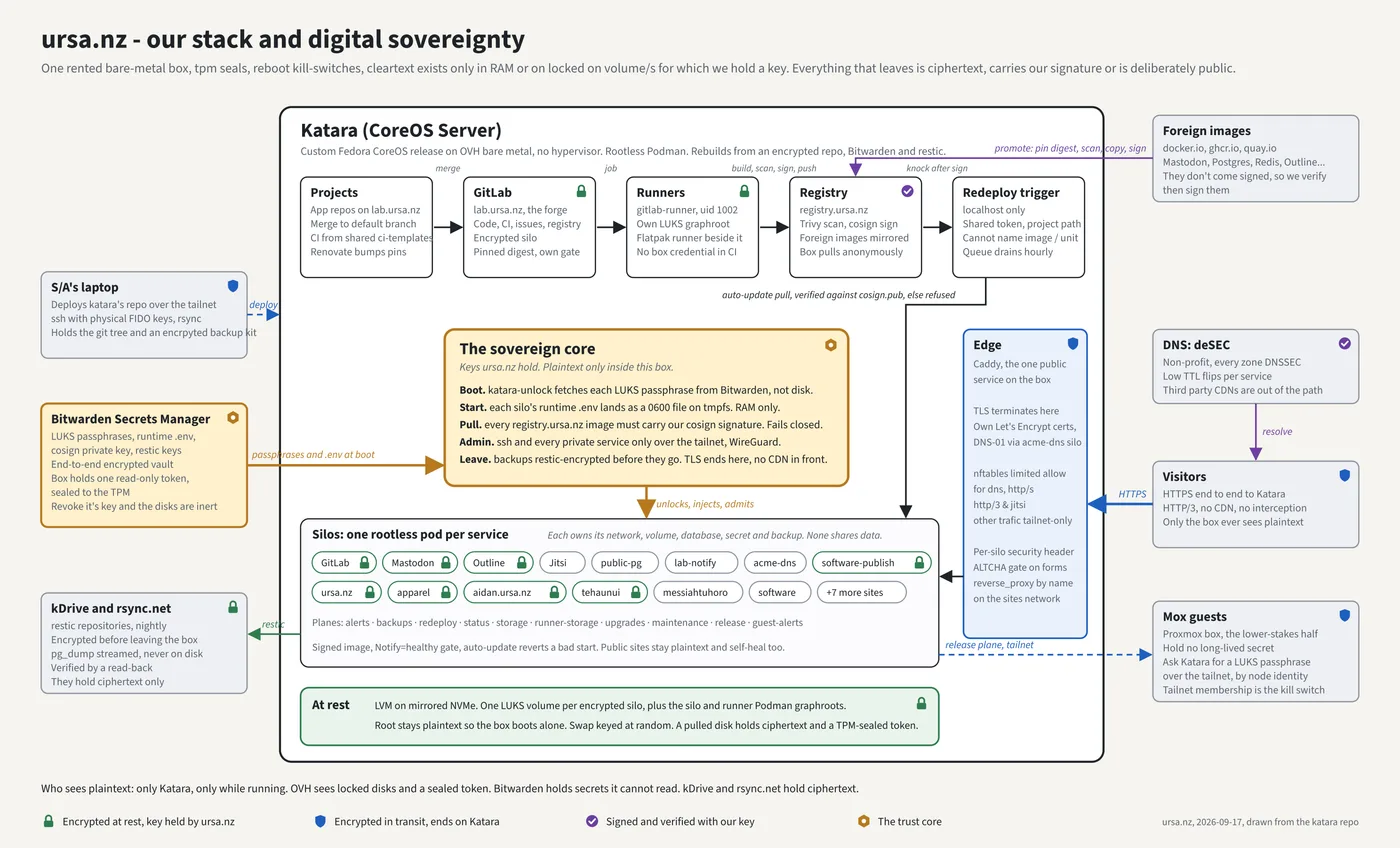
If you’re interested, you can access the sort of pretty graphic above which attempts to explain all this in more detail without you falling asleep in full size here.
Now let me do as they do on the discovery channel, err um I mean: Lemmy and Reddit, and Explain Like I’m 5 years old (ELI5):
Big companies like Google, Apple, Meta and Microsoft hold most of our photos, messages and documents. A password keeps other people out, but it does nothing to stop the company itself reading what you store, selling it, feeding it to AI or handing it to a government. Once your data leaves your hands it is gone. So I say no US company can be trusted with anything sensitive, and Europe is only a little better.
For Aboriginal and Māori communities, sovereignty means our people decide who sees and uses our knowledge. Most of life now happens online, so that same fight happens online too. Digital sovereignty means our data, in our hands, on our rules.
The fix is small and cheap. ursa.nz rents a bare metal server (no landlord looking over the shoulder), encrypts the drives so a pulled disk is useless, and only allows changes from a laptop with a physical key plugged in. On top sit open source stand-ins for Zoom, a wiki, social media and code hosting. It is a template you can copy, remix or bin, and a way to keep sharing story and ideas without feeding the colonial capitalist machine.
If you want to yarn about any of this, for whatever reason, sing out: aidan@ursa.nz
Hope you enjoyed the ramblings of my inner teen queen.
A x
Footnotes
-
jeffrey bezos, just fuck off you massive pervert and slaver. ↩
-
any security with a backdoor is no security at all. a back door with a key is pickable by anyone who can pick a lock (that’s a lot of people). it is, therefore, inherently not e2ee. ↩
-
the double edge trickery is gnarly here. we are denied our right to share and ‘un-share’ our knowledge, to pass learnings to those we see fit. More importantly, our Elders are often extracted from, recorded or uploaded, and never compensated, asked for appropriate permission, or even informed of where story is moving to. Again, the only safe(r) step is a full-stack ‘our data in our hands’ approach that means custodians remain in custodial relation to their knowledge and information in the digital space. This is largely deemed impossible, for myriad reasons, and I respect that stance immensely. However, I believe we can use the tooling of technology to create something genuinely better for our communities; it just requires thinking and tooling that you won’t get in red hat’s digital sovereignty blog column. ↩ ↩2
-
this isn’t meant to be exhaustive, and not to suggest any particular similarities between these providers. fly.io, netlify, alibaba cloud, hetzner and many others exist across the world, and all pose similar problems for the argument unfolding in this text. ↩
-
I’m excluding here services which do offer encryption at rest for disks, and encrypted memory, because they are priced well outside consumer range from the big three. Targeted more towards enterprises ~ particularly the big corporate, military industrial complex, war, and pharma markets. ↩
-
I would include in this that no us-backed social media can be trusted at all inc: tiktok/ex-bytedance, x/ex-twitter, snap (snapchat) and so on. ↩
-
claude often provides lectures on safety when prompts contain anything verging on “culture”; other providers, particularly chatgpt, midjourney, gemini have no qualms spitting out verbatim law as told by an Aunty, or just making cultural knowledge and iconography up with no second guessing (itself, because it’s not. fucking. sentient.). ↩
-
at least, not “just” the commercial internet. I’m looking quite seriously at lora and other local internet replacement systems for community knowledge sharing and creation. ↩
-
I’ll need to elaborate on this in a future post, but essentially this service enables us to digitally sign and deliver applications, tools, websites and communications that we can (relatively speaking) assure to be as accurate as human knowledge transfer can be. ↩